GEO · AI Search Visibility · AI Relations · ChatGPT · Gemini · Perplexity
Generative engine optimization: why the name gets AI search wrong
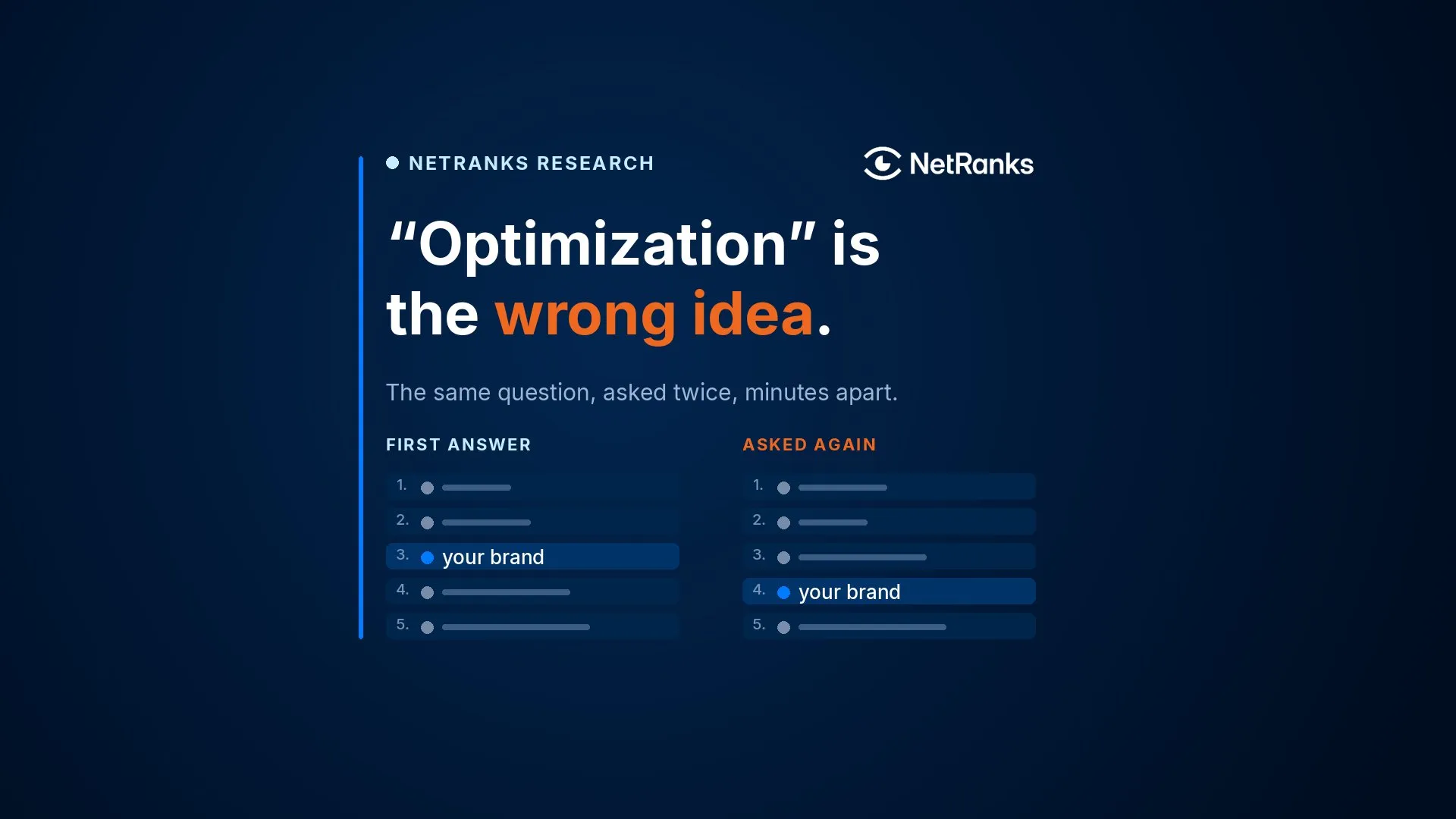
Generative engine optimization borrows the SEO mindset. Our data on 853,320 AI answers shows why that mindset fails, and why the work is closer to PR.
If you've read anything about AI search this year, you've come across generative engine optimization, or GEO. It has become the default name for the work of getting a brand mentioned in ChatGPT, Gemini and Perplexity answers, and it's easy to see why it caught on. It sounds like SEO, and SEO is something marketing teams already know how to budget for, hire for and report on.
We think the name is wrong. It carries an assumption about how AI search works that the data doesn't support, and that assumption leads teams to do the wrong work and to measure it badly.
What the name assumes
SEO works because a search engine is, at heart, a lookup. The same query returns the same ranked list, so you can study which pages rise, work out what they have in common and change your own pages to match. Google also conveniently provides the whole analytics layer that goes with it. All of it is free, and it comes from the engine itself.
None of that exists for AI search. NetRanks founder Reha Sönmez puts the difference simply:
Ask Google the same question twice and you get ninety-nine percent the same answer. With AI search, that is not the case; there is a non-deterministic component.
Calling the new work "optimization" brings the old mindset along with it: if there is something to optimize, there is a checklist somewhere, and the job is to find it and work through it. A language model doesn't work that way. It answers from its own shifting sense of which sources and brands are relevant and credible, and it can give a different answer to the same question the next time it's asked.
Why that matters in practice
We track AI answers at scale for our customers, and three things show up again and again.
There is no fixed position to climb. A rank taken from a single answer tells you very little, because the next answer to the same question can name a different set of brands in a different order. What matters is how often you are named across many answers, which is a measurement question before it is anything else.
The engines don't agree with each other. In one of our studies of 853,320 answers collected across three engines between 15 June and 13 September 2026, YouTube was the most cited domain on Gemini. On Perplexity, YouTube citations fell overnight on 12 August, from 1,711 in a day to 221. ChatGPT did not cite a single YouTube page until 30 July, forty-five days in, across 554,212 source links. A list of ranking factors for "AI search" would really have to be three lists.
The same work takes different time to show up on each engine. One of our clients, a clinic, published site changes in rounds from 22 April onwards. ChatGPT moved first. It had been running between 3% and 7% of answers through March and April, and reached 15% to 18% by late May, after the second and third rounds. Perplexity went the other way, falling from about 3% to under 1% and staying there for twelve weeks, then reaching 14% in the week of 13 July, nine days after a later round. Gemini stayed near 1% through late July and early August, then climbed to between 8% and 9% from 24 August, more than six weeks after the last round, with nothing nearby to explain it. Averaged across the three engines, the number barely moved for the first two months, from about 5% to about 6%. A team working to an optimization mindset would probably have read that as failure and started undoing the changes before they had time to affect all the engines.
What the work actually is
Getting recommended by an AI engine is better understood as building trust: helping the model understand your industry and your brand well enough that it is more likely to name you. That is not an optimization problem. It is a long-term trust-building problem.
This puts it much closer to public relations than to traditional SEO. PR is about shaping what a third party says about you when you're not in the room, and that is exactly the position a brand is in when someone asks ChatGPT which company to choose. We call this AI Relations.
Frequently Asked Questions
Is generative engine optimization the same as SEO?
No. SEO works on a deterministic ranking that returns the same results for the same query. AI engines answer probabilistically, differ from one another and change their sourcing without notice, so the SEO playbook of tuning pages to ranking factors doesn't transfer.
Can you optimize for ChatGPT?
Not in the SEO sense. What you can do is help ChatGPT, Gemini and Perplexity understand your brand well enough to recommend it by measuring its output at scale, understanding what trust signals affect their answers and doing the work of earning their trust, engine by engine.
What is AI Relations?
It is the practice of earning a brand's standing with AI engines: making sure they understand what the brand does and trust it enough to recommend it.