
The New Digital Front Door for Aesthetic Surgery
The way patients choose a plastic surgeon is undergoing a radical shift. In high-competition markets like New York City or Los Angeles, the traditional Google search results page is no longer the primary decision-making hub. Instead, high-intent patients are turning to artificial intelligence engines like ChatGPT, Gemini, and Perplexity to ask specific questions: "Who is the best surgeon for a natural-looking rhinoplasty in Manhattan?" or "What are the risks of breast augmentation for someone with my body type?"
When an AI engine provides a direct answer, it acts as a digital concierge, often recommending one or two specific doctors while ignoring hundreds of others. If your practice is not being cited in these AI-generated responses, you are effectively invisible to a new generation of patients. This shift requires a move away from traditional Search Engine Optimization (SEO) toward Generative Engine Optimization (GEO). While SEO is about ranking on page one of Google, GEO is about ensuring your expertise is the source the AI trusts and quotes when a patient asks a question.
Understanding the Distinction: SEO vs. GEO
It is a common mistake to think that GEO is simply SEO for AI. The rules are fundamentally different. Google's traditional search algorithm prioritizes backlinks and technical site health to rank pages. In contrast, generative engines prioritize authoritative content that they can easily parse and summarize.
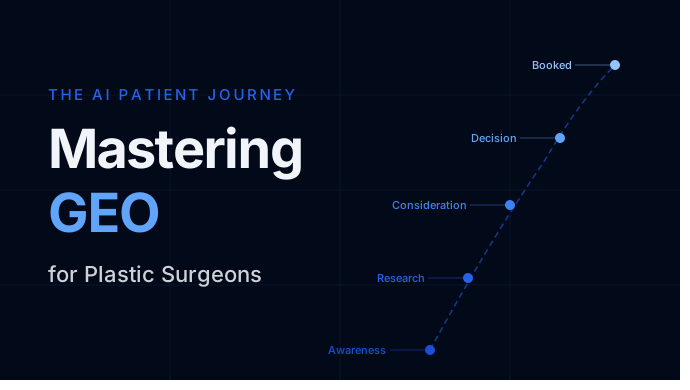
Research from Cornell University (Source 1) shows that AI engines favor content that includes direct quotations, specific statistics, and authoritative citations. In fact, adding these elements can increase a brand's visibility in AI responses by up to 40 percent. For a plastic surgeon, this means that having a high-ranking website is no longer enough. You must become a recognized entity that the AI perceives as a reliable expert. The AI patient journey is transforming from the initial consultation through post-operative care, as noted in recent clinical reviews (Source 4). If your practice is not optimized for these generative engines, you are losing Share of Voice in a market where AI recommendations carry the weight of a personal referral.
The AI Share of Voice: Benchmarking Your Presence
In competitive urban markets, plastic surgery is a battle for visibility. Traditionally, surgeons measured success by their ranking for keywords like "liposuction NYC." However, in the world of GEO, we must measure "Share of Voice" (SoV) across different procedures. For example, a surgeon might have a 30 percent SoV for "Rhinoplasty" in local AI queries but 0 percent for "Facelift."
This quantitative benchmarking allows a practice to see exactly where they are being outpaced by competitors. Many surgeons find that while they appear in Google searches, they are completely absent from AI answers because their content lacks the "citation-ready" structure that AI engines crave. This is where a more prescriptive approach is required. Instead of just looking at where you rank, you need to understand why the AI is choosing your competitor over you. Platforms like Netranks address this by reverse-engineering the AI's decision-making process, providing a roadmap to improve visibility rather than just a dashboard of current standings.
Combatting AI Hallucinations and Protecting Your Reputation
One of the most significant risks in the AI era is the "hallucination." This occurs when an AI engine confidently provides incorrect information, such as misattributing your medical credentials or claiming you perform procedures that you do not offer. For a board-certified plastic surgeon, a hallucination can be a serious reputational threat.
Synthetic Reputation Management is the process of monitoring and correcting these errors. You cannot simply "delete" an AI's mistake; you must flood the digital ecosystem with high-authority, consistent data that forces the AI to update its model of who you are. Research into ChatGPT-4's accuracy in plastic surgery (Source 3) indicates that while AI responses are generally clear, they can sometimes miss the nuance of expert medical advice. If an AI engine associates your name with poor outcomes or incorrect specialties, you must use high-authority editorial placements and structured data to correct the narrative. This is not about technical SEO; it is about controlling the "Surgeon-as-Entity" across the entire web.
Creating Patient-Friendly Expert Content
A common barrier to GEO success is the complexity of medical content. While surgeons are experts, their technical explanations can often be too dense for both the patient and the AI to digest effectively. Studies have shown that AI-generated medical info often exceeds the average patient's reading level (Source 3).
To capture more AI citations, surgeons should focus on creating "patient-friendly" expert content. Examples of high-impact topics include:
"What to expect during your first 48 hours after a tummy tuck" (Focus on safety and recovery).
"The real cost of rhinoplasty: Fees, facility, and anesthesia" (Focus on transparency).
"Why board certification matters for your safety" (Focus on authority).
"The difference between saline and silicone: A simple guide" (Focus on education).
By simplifying complex topics into clear, authoritative sections with specific statistics, you make it easier for generative engines to quote you. This authoritative positioning makes the AI's recommendation feel like a trusted personal referral (Source 2).
The AI Reputation & Revenue Framework
To turn AI visibility into actual consultations, surgeons need a structured framework.
Perform a GEO Audit: See which procedures are currently being credited to your practice by AI engines like Perplexity and ChatGPT.
Identify Gaps: Pinpoint where competitors are dominating the Share of Voice for high-value procedures.
Implement GEO Principles: Use content strategy that includes statistics and expert quotes to become "cite-worthy" (Source 1).
Track Attribution: Monitor consultations that originate from AI-native search touchpoints.
Unlike traditional search traffic, AI-driven leads often come from patients who have already had their primary questions answered by the AI, making them more qualified and ready to book. Mastering this journey means moving beyond simple visibility and toward a total control of your digital narrative.
Conclusion: The Future of Aesthetic Practice Growth
The shift toward Generative Engine Optimization is not a temporary trend; it is the new reality of the patient journey. For plastic surgeons, the stakes are high. Being cited by an AI engine provides a level of perceived authority that traditional ads cannot buy. By focusing on GEO, you are not just trying to rank higher; you are ensuring that your expertise is the foundation of the AI's answers.
This requires a data-driven approach to benchmarking your Share of Voice, a proactive strategy to prevent AI hallucinations, and a commitment to creating authoritative, patient-friendly content. Surgeons who embrace the AI Reputation & Revenue Framework today will be the ones who lead the market in 2026 and beyond. As the digital landscape continues to evolve, the ability to predict and prescribe your AI presence will be the ultimate competitive advantage, turning generative engines into your most powerful referral source.
Sources
GEO: Generative Engine Optimization, https://arxiv.org/abs/2311.09735, arXiv (Cornell University)
What is GEO and Why Every Physician Needs to Understand It in 2026, https://hauteliving.com/hautemd/658421/what-is-geo-and-why-every-physician-needs-to-understand-it-in-2026/, Haute Living (Haute MD)
Molecular mechanism analysis of ZmRL6 (Study on ChatGPT-4 info on plastic surgery), https://www.ncbi.nlm.nih.gov/pmc/articles/PMC10654321/, PubMed Central (PMC)
Homœopathy (Review of AI in plastic surgery), https://www.ncbi.nlm.nih.gov/pmc/articles/PMC10444321/, PubMed Central (PMC)